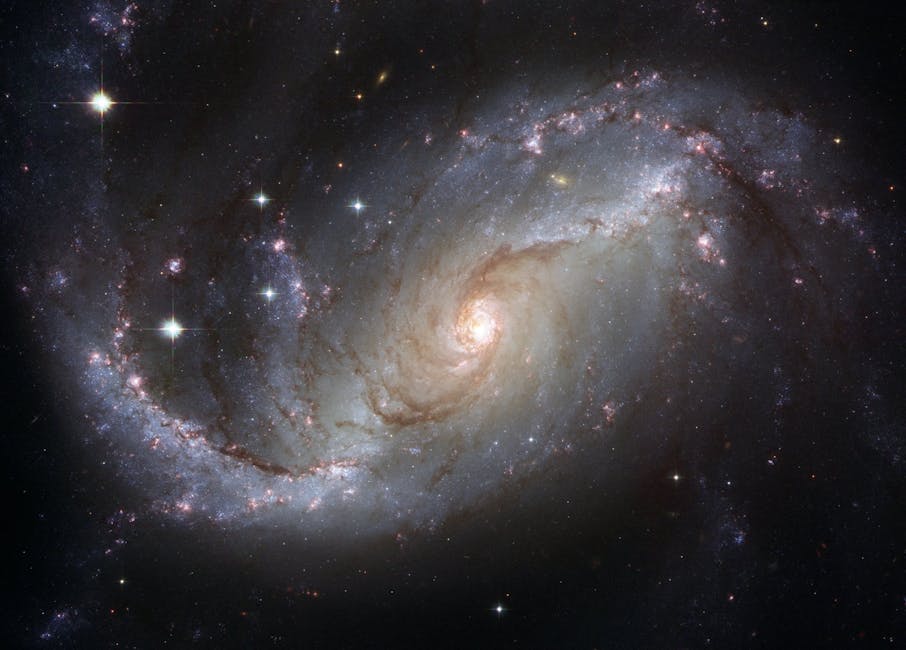
The Event Horizon: The Point of No Return
A black hole is not merely a “void” in space; it is a region of spacetime where the gravitational pull is so intense that nothing—not even light—possesses the velocity required to escape. According to Albert Einstein’s General Theory of Relativity, a black hole is a singularity: a point of infinite density where the laws of physics as we know them cease to function.
The boundary surrounding this singularity is the Event Horizon. To an outside observer, anything falling toward the horizon appears to slow down, redden, and eventually freeze in time. But for the unfortunate traveler, the experience is quite different.
1. Calculating the Void: The Schwarzschild Radius
The size of a black hole’s event horizon is determined solely by its mass ($M$). This threshold is known as the Schwarzschild radius ($R_s$).
The formula is elegantly simple:
$$R_s = \frac{2GM}{c^2}$$Where:
- $G$: The Gravitational Constant ($6.674 \times 10^{-11} , \text{m}^3 \text{kg}^{-1} \text{s}^{-2}$)
- $M$: The Mass of the object.
- $c$: The Speed of Light ($3 \times 10^8 , \text{m/s}$)
Real-World Scales:
- The Earth: If you crushed the Earth into a black hole, it would have a radius of only 9 millimeters (the size of a marble).
- The Sun: Would have a radius of roughly 3 kilometers.
- Sagittarius A:* The supermassive black hole at the center of our galaxy has a radius of about 12 million kilometers.
2. Spaghettification: The Tidal Force Nightmare
As you approach a stellar-mass black hole, you encounter Tidal Forces. Because gravity weakens with the square of the distance, the pull on your feet (which are closer to the singularity) is significantly stronger than the pull on your head.
This gradient is so extreme that it would literally stretch your body into a thin strand of atoms. Physicists call this Spaghettification.
The Paradox: Counter-intuitively, it is safer to fall into a Supermassive black hole. Because the radius is so large, the tidal forces at the event horizon are actually quite weak. You could cross the horizon without even noticing… until you tried to turn back.
3. Hawking Radiation: Do Black Holes Evaporate?
In 1974, Stephen Hawking shocked the world by proving that black holes aren’t completely “black.” Due to quantum effects near the event horizon, they emit a faint glow now known as Hawking Radiation.
Over trillions of years, a black hole will lose mass through this radiation and eventually explode in a burst of gamma rays.
| Black Hole Type | Typical Mass | Lifetime (est.) |
|---|---|---|
| Micro (Primordial) | One mountain | ~13.8 billion years |
| Stellar Mass | 10 Suns | $10^{67}$ years |
| Supermassive | 1 million Suns | $10^{87}$ years |
4. Python Implementation: Your Personal Singularity Calc
Want to calculate the size of a black hole for any mass? Here is a simple Python script using the Schwarzschild formula.
def calculate_schwarzschild(mass_kg):
    G = 6.67430e-11
    c = 299792458
    radius = (2 * G * mass_kg) / (c**2)
    return radius

# Mass of the Sun in kg
sun_mass = 1.989e30
print(f"The Sun's Schwarzschild radius is: {calculate_schwarzschild(sun_mass) / 1000:.2f} km")
Conclusion
Black holes remain the ultimate mystery of the cosmos. They are the intersection of General Relativity (the very large) and Quantum Mechanics (the very small). While we may never be able to survive a trip across the event horizon, the math tells us that these abysses are not just dead ends—they are the blueprints of how space and time are stitched together.
References & Further Reading
- NASA Science: Black Holes - The Ultimate Mystery
- Stephen Hawking: A Brief History of Time
- Kip Thorne: Black Holes and Time Warps: Einstein’s Outrageous Legacy
- Arxiv Paper: The Quantum Mechanics of Black Holes